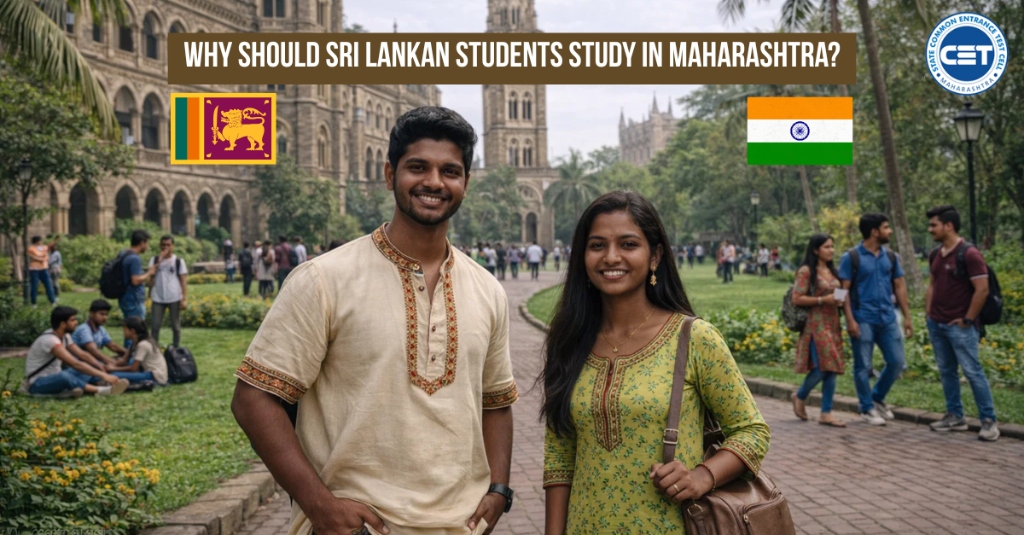
Sri Lankan students join Maharashtra colleges through the Foreign National route on fn.mahacet.org without sitting JEE Main or MHT CET. Engineering, Pharmacy, B.Arch, and most other programs admit on A-Level or equivalent 12th-grade merit, with the State CET Cell handling eligibility, verification, and college allocation under one transparent process.
If you are a Sri Lankan student applying for higher education in Maharashtra, India, you do not need to take MHT CET or JEE Main for Engineering, Technology, Pharmacy, or Hotel Management. Admission is based on your 12th grade or GCE A-Level results. Medical (MBBS, BDS, AYUSH) needs NEET with cutoff, and Architecture needs NATA.
Sri Lankan students typically apply through the Foreign National (FN) category at fn.mahacet.org.
Why Sri Lankan Students Study in Maharashtra
- No entrance exam for most courses.
- 15% Supernumerary Quota. Extra seats reserved for International applicants.
- Single Window System. The full process runs through one portal.
- Dietary comfort. Mumbai and Pune have strong vegetarian, seafood, and international options.
- Safety. Mumbai and Pune are among India's safest major cities.
- Connectivity. Direct flights from Colombo to Mumbai and Chennai make family visits practical.
- Climate. Pune offers pleasant, moderate weather.
- International Student Cells (ISC). Administrative support and housing guidance.
- Industry exposure. Mumbai and Pune are India's top finance, IT, and automotive hubs.
Who Can Apply From Sri Lanka
The student, the student's Parent (Father or Mother), or a Legal Guardian holding a valid Court Guardianship Certificate issued by an Indian Court under the Guardians and Wards Act, 1890 can file the application. Aunts, uncles, grandparents, cousins, and siblings are not eligible, even if they are Indian residents or NRIs.
The 3-Step Payment and Verification Process
The admission workflow has three clear stages. Each unlocks the next.
Stage 1. Eligibility Fee
Pay the Eligibility Fee and upload your documents. Virtual verification begins. Once eligibility is confirmed, you can see the Provisional Eligibility Letter in view-only mode. You cannot download it yet.
Stage 2. One-Time Processing Fee
Paid after eligibility is confirmed. This unlocks the download of the Provisional Eligibility Letter, enables Visa or OCI or Country ID uploads, and marks you as eligible for the Merit List and Seat Allotment.
Stage 3. College Fees
Paid online through the portal after seat allotment. This unlocks the Provisional Admission Letter (also called the Provisional Allotment Letter) for download, enables upload of medical and residential proof, and initiates Physical Document Verification.
Important. Physical Document Verification happens only after all three payments are complete, and it happens at the Allocated College, not at any Facilitation Center or separate office. You bring your Original Documents to the college when you report.
Year-1 Admission Cost — Sri Lanka (Indicative)
Total spend split into State CET Cell administrative fees (paid in USD via CCAvenue) and college tuition (paid in INR to the allotted college).
| Component | USD | INR (approx) | LKR (approx) | Paid To | When |
|---|---|---|---|---|---|
| MH-CET Eligibility Fee | $50 | ₹4,150 | 15,000 | State CET Cell (CCAvenue) | Stage 1 — at registration |
| MH-CET Processing Fee | $1,150 | ₹95,500 | 345,000 | State CET Cell (CCAvenue) | Stage 4 — after eligibility approval |
| Engineering Tuition (annual, indicative) | $1,800 – $4,800 | ₹1.5 L – ₹4 L | 540,000 – 1,440,000 | Allotted college | After college allotment |
| Pharmacy Tuition (annual, indicative) | $1,200 – $3,000 | ₹1 L – ₹2.5 L | 360,000 – 900,000 | Allotted college | After college allotment |
| B.Arch Tuition (annual, indicative) | $1,800 – $4,200 | ₹1.5 L – ₹3.5 L | 540,000 – 1,260,000 | Allotted college | After college allotment |
| MBA / MMS Tuition (annual, indicative) | $2,400 – $7,200 | ₹2 L – ₹6 L | 720,000 – 2,160,000 | Allotted college | After college allotment |
| Hostel + Mess (optional, annual) | $1,000 – $2,000 | ₹0.85 L – ₹1.7 L | 300,000 – 600,000 | College / Hostel | Year-round |
Currency conversions are indicative (1 USD ≈ 300 LKR, 1 USD ≈ ₹83) and fluctuate daily; CCAvenue applies the live rate at the time of payment. College tuition varies by tier — state-aided colleges sit at the lower end, top private institutions at the higher end.
MH-CET International Admission Timeline (Indicative)
Indicative monthly windows for each admission cycle. Actual dates are published annually on fn.mahacet.org and may shift by 2–3 weeks.
| Stage | Indicative Window | Duration | What You Do |
|---|---|---|---|
| Stage 1 | June – early July | ~30 days | Online registration on fn.mahacet.org; create login and personal profile |
| Stage 2 | June – mid-July | ~14 days | Upload document checklist; pay USD 50 Eligibility Fee via CCAvenue |
| Stage 3 | July | 7–14 days | State CET Cell verifies eligibility; status updates on portal |
| Stage 4 | Late July – early August | ~7 days | Pay USD 1,150 Processing Fee to confirm participation in allotment |
| Stage 5 | August – early September | 14–21 days | Choice filling; merit-based college allotment by State CET Cell |
| Stage 6 | September – October | ~14 days | Download Provisional Admission Letter; pay college tuition; report to allotted college |
Stages 1–4 are governed by the State CET Cell on fn.mahacet.org. Stage 5 onward is between the candidate and the allotted college.
Frequently Asked Questions
Do Sri Lankan students need MHT CET or JEE?
No. Engineering, Technology, Pharmacy, and Hotel Management admissions are merit-based on 12th grade or GCE A-Level scores.
Can my cousin in India apply for me?
No. Only the Parent or an Indian Court-appointed Legal Guardian.
Is NEET required for MBBS?
Yes, with the published cutoff.
How are my A-Level marks evaluated?
Colleges use published equivalency frameworks. The category-check workflow clarifies the required academic documents.
Where does physical verification happen?
At the Allocated College, after all three payments.